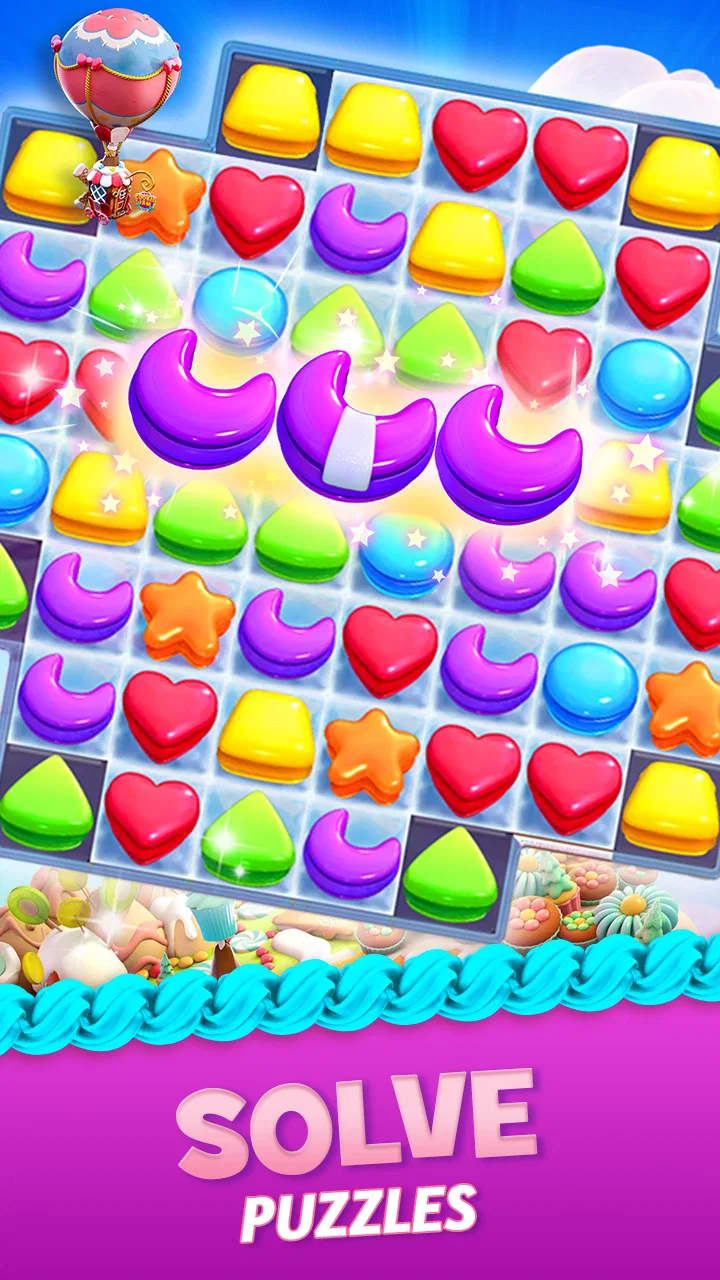
Cookie Jam Blast™ Match 3 Game
- 4.5
- Rating
- 10.00M
- Installs
- Free
- Price

 Analysis by App-foxy
I picked up Cookie Jam Blast™ Match 3 Game expecting a quick candy-and-cookie puzzle for spare minutes, and that is exactly where it works best. It is a free puzzle game from Jam City, Inc. built around matching pieces on a board, creating combinations, and clearing objectives before the available moves run out. The presentation is bright and cheerful, but the useful question is less about its colorful theme and more about whether it fits the way you actually play. In my experience, it is easy to start, comfortable for short sessions, and gradually more demanding than its friendly appearance suggests.
The game is especially easy to imagine on a shared household tablet or a phone passed around during a quiet moment. One person can play a few boards while waiting for dinner, another can take over later, and nobody needs to understand a complicated control scheme first. That simplicity is a real strength. At the same time, a shared device creates practical boundaries: progress, purchases, and the general play experience should be treated as belonging to the person using the relevant game account or device profile, not as a communal scorebook unless everyone agrees on how to use it.
How the matching gameplay feels in everyday use
The core loop is familiar: look for groups of matching items, make a move, watch the board react, and try to complete the level target. That familiarity makes the first few minutes almost effortless. I did not need a tutorial-heavy introduction to understand what the board wanted from me. The appeal comes from the small decisions between obvious matches. Do I clear a simple group now, or set up a larger chain that may open more space later? That choice gives the game more substance than simply tapping the first available combination.
You May Also Like

 Blood Strike: 2.5 Anniversary
Blood Strike’s Loadouts Turn Every Drop Into a Tactical Gamble
A close look at Blood Strike’s custom loadouts: how fast access to signature weapons reshapes its battle royale rhythm, rewards preparation, and narrows the gap between fights.

 Pandora - Music & Podcasts
Pandora’s Music Is Easy to Start, but Harder to Recover
Pandora’s strength is its low-effort path from a seed to a station. Its weak spot is how much confidence it asks you to place in connection, setup, and quiet recovery.

 8 Ball Pool
 Is Built on Rivalries, Rematches, and Routine
A close look at the rivalries, rematches, shared routines, and unanswered safety questions that turn a quick pool match into a persistent mobile community.

 Samsung Music
’s Quiet Strength Is Playing What You Already Own
Its reach comes less from spectacle than from dependable access to a personal library. That simplicity is both the app’s strongest retention engine and its ceiling.

 AccuWeather: Weather Radar
AccuWeather Review: A Quick, Clear Forecast for Everyday Decisions
For everyday plans, the best forecast is the one you can understand quickly. AccuWeather makes rain timing, radar, and local conditions easy to act on, with a few trade-offs.

 Hill Climb Racing
Why Hill Climb Racing Still Turns Crashes Into One More Run
A tiny car, a bumpy hill and one more upgrade: Hill Climb Racing keeps resurfacing because its simple chaos makes every near-miss feel personal.
More From Our News Desk
View All News


For a normal weekday, the best use case is a short break with a clear stopping point. A completed level feels more satisfying than an endless activity because each board asks for a fresh solution. I found it suitable for the kind of session where I have a few minutes but do not want to commit to a story, multiplayer match, or long strategy campaign. It also works well when someone nearby is watching, since the board is visually readable and another person can suggest a move without needing to hold the phone.
That shared-device quality changes the way I judge it. A game that requires constant concentration or precise timing is awkward when several people are taking turns. This one is more forgiving in that respect because the important action is usually deciding where to make the next match. A child, parent, or visitor can understand the immediate goal quickly. Still, taking turns can become confusing if one person starts a level and another finishes it, so I would avoid treating a single progress path as a family competition unless everyone is comfortable with that arrangement.
Why the familiar format still has value
Match-three games are often dismissed as interchangeable, but small differences in board goals and move planning matter. Cookie Jam Blast keeps the basic idea approachable while giving each level enough structure to make the next move worth considering. It is not trying to replace a deep turn-based puzzle game. Instead, it sits in the middle ground between a completely mindless tapper and a demanding logic exercise.
Compared with a traditional newspaper-style puzzle, it is more animated and immediate. Compared with a competitive online game, it is calmer and does not make the household coordinate around a live match. Compared with a minimalist block puzzle, it has a stronger theme and a more guided sense of progress. I would choose it over those alternatives when I want quick visual feedback and a sequence of small goals. I would choose a more purely strategic puzzle when I want to think through a position without distractions or a themed reward loop.
The important trade-off is that accessibility can make the early experience feel light. Players who want a single, elegant puzzle system with unlimited experimentation may find the level-based format less satisfying. Cookie Jam Blast is about moving forward through individual challenges, not endlessly refining one perfect board. That distinction helped me decide when to use it: it is a casual companion for breaks, not my first choice for serious puzzle study.
Using it on a household or shared device
If several people use the same phone or tablet, I would establish a simple routine before anyone begins. Decide whose game progress is being used, whether purchases are allowed, and whether other players may spend any earned or purchased resources. This is not a criticism of the game itself; it is just sensible housekeeping for any free game that offers optional in-app purchases. The listed purchase range runs from $0.99 to $299.99 per item, so a shared device deserves more attention than a game that has no purchase options at all.
I would also keep the game separate from a child’s casual tapping time unless an adult is nearby to explain what each on-screen prompt means. A colorful interface can make every button look like part of the game, while a purchase prompt is a different kind of decision. The safest household habit is to let the account owner handle anything involving payment and to make it clear that finishing a level does not require buying something.
For adults sharing a device, coordination is mostly about avoiding accidental disruption. If one person is working through levels, another person should not reset, reinstall, or change the active profile simply to start over. Even without inventing special family features, that basic rule prevents the most common kind of household frustration: somebody opens a familiar game and discovers that the visible progress no longer belongs to them.
Age context and trust
The game carries an Everyone content rating, which matches my impression of its bright, non-threatening puzzle presentation. That makes it easier to place in a family setting than a game built around combat, frightening scenes, or mature themes. However, an age rating is not the same thing as a complete household agreement. Younger players may still need help understanding optional purchases, screen-time limits, and whose progress they are using.
I would be comfortable introducing the basic matching play to a child while staying close enough to answer questions about prompts and spending. For an older player, the main issue is less content and more self-management. The level structure encourages “one more board,” and that can stretch a short break into a longer session. In a family setting, a clear stopping rule works better than assuming the cheerful tone will naturally signal when to put the device down.
Trust also matters between adults. If a tablet is shared by partners, roommates, or relatives, the person who owns the payment method should know that the game includes optional purchases. Nobody should assume that “free” means every part of the experience is cost-free. I appreciate the ability to begin without paying, but I would still treat the game like any other app connected to a device that may contain a payment account.
Progress, difficulty, and the points where patience matters
The most interesting part of the experience is the gradual shift from obvious matches to planning. Early boards let the player learn the visual language of the game. Later, I found myself looking beyond the first available move and thinking about how a match would affect the rest of the board. That is where the game becomes a better time-filler: the action remains simple, but the order of moves begins to matter.
One useful habit is to scan the whole board before touching anything. In a fast-looking puzzle, it is tempting to make the first match that catches the eye. A wider scan can reveal a move that opens a blocked area or creates a more useful chain. I also prefer preserving flexible pieces when the board is tight rather than immediately using every convenient combination. This is not a guaranteed solution for every level, but it reduces the feeling that I am playing reactively.
Another practical tip is to treat the level objective as the priority, not the prettiest animation. Large combinations are satisfying, but they are only helpful when they contribute to clearing the required targets or creating space. I have had better results when I ask, “What does this board need next?” instead of chasing the biggest-looking move. That small change makes the game feel more strategic without turning it into a complicated calculation exercise.
When a level becomes stubborn, I would take a short break rather than immediately spending anything. Returning with a fresh view often exposes a move that was missed because I was focused on one corner. This is particularly useful on a shared device, where another household member may notice a simple option without carrying the frustration of the previous attempt. Passing the phone over for a second opinion can become part of the fun, provided the original player is happy to share control.
What the free model means in practice
Cookie Jam Blast is free to install, which lowers the barrier to trying it. The trade-off is the presence of optional in-app purchases, and the upper end of the listed range is substantial. I would not recommend approaching it with the assumption that every obstacle should be solved by paying. The better test is whether the unpurchased play already gives you enough enjoyment to justify keeping it.
For a household, I would make the purchase boundary explicit: no spending without permission, and no confusing a temporary desire to finish a board with a genuine need. If the game becomes enjoyable because of its puzzles, it should remain enjoyable when the player waits, retries, or returns later. If the main attraction becomes accelerating progress, a free puzzle game may no longer be the right fit for that person.
This is also where Cookie Jam Blast differs from a fully premium puzzle title. A paid game often gives a more controlled experience from the start, while a free-to-play game is easier to sample but asks the player to manage optional spending and patience. Neither model is automatically better. I prefer this one when I am undecided and want to test the basic loop first. I prefer a premium alternative when I want a clean, uninterrupted puzzle experience and am willing to pay upfront for that simplicity.
Device compatibility and practical expectations
The current version is 13.40.118, and the game supports Android 7.0 or later. That makes it relevant to people using older Android hardware, although the experience will still depend on the condition and performance of the particular phone or tablet. On a shared household device, I would check that the operating system meets the requirement before planning around it, especially if the tablet is several years old.
The game has reached over 10 million installs, so it is clearly not an obscure experiment. Its average rating is 4.5, based on a large body of player feedback, which fits my view that the central matching loop is broadly appealing. Those figures do not remove the need to judge the purchase model or the level pacing for yourself, but they do suggest that the game has found a substantial audience beyond a brief novelty period.
It is worth remembering that a popular casual game can still be wrong for a particular player. Someone who dislikes colorful themes, prefers offline paper puzzles, or wants complete control over every rule may not enjoy this format. Likewise, a person looking for direct competition with friends should choose a game designed around multiplayer interaction rather than expecting a solo level game to provide that same social structure.
Who should install it, and who should skip it
I would recommend Cookie Jam Blast to someone who wants approachable match-three puzzles, a bright presentation, and levels that fit naturally into short breaks. It is a good candidate for a shared tablet when the household agrees on whose progress is active and how purchases are handled. It also suits players who enjoy improving through observation: scanning the board, choosing a useful order, and learning from a failed attempt.
I would be more cautious about recommending it to someone who is easily drawn into repeated retries or who wants a game with no optional spending decisions. The free entry point is convenient, but the purchase range means the app deserves ordinary financial boundaries, particularly on a device used by children. Players who want a quiet, abstract puzzle may also prefer a simpler alternative without the cookie-and-candy theme.
My household test is straightforward. If one person can play for a few minutes, stop without resentment, and hand the device to someone else without risking progress or spending, the game fits shared use well. If every session turns into an argument over turns, purchases, or who owns the level path, the problem is not solved by the game’s friendly appearance. In that case, separate profiles or a different puzzle would be a better practical choice.
After spending time with it, I see the game as a polished casual option rather than a deep puzzle masterpiece. Its strength is the balance between immediate understanding and enough board planning to keep familiar matches interesting. Its weakness is the tension that can come with a free-to-play structure, especially when a shared device or a younger player is involved.
My final recommendation is to try it as a controlled, low-pressure break game. Keep the purchase rules clear, decide whose progress matters on a shared device, and resist treating every difficult board as a reason to spend. If you enjoy the small satisfaction of finding a better move and want a colorful puzzle that works in short sessions, Jam City, Inc.’s game is worth a place on your phone or tablet. If you want a completely uninterrupted experience or a more demanding logic challenge, I would look elsewhere instead.
FAQs for Cookie Jam Blast™ Match 3 Game
01What is Cookie Jam Blast™ Match 3 Game?
Cookie Jam Blast™ is a colorful match-3 puzzle game where you swap and combine sweet treats to complete level objectives. Each stage may ask you to clear specific tiles, break obstacles, collect ingredients, or reach a target score within a limited number of moves. Its bright presentation, short levels, and gradually increasing difficulty make it suitable for casual play, although later stages require more planning.
02Can I play Cookie Jam Blast™ offline?
Many standard puzzle levels can generally be played without a constant internet connection, which is useful when traveling or when mobile data is unavailable. However, some features may require online access, including advertisements, in-app purchases, cloud synchronization, events, updates, and certain social or promotional content. Availability can also depend on the installed version, so it is best to launch the game online at least once after installation.
03Is Cookie Jam Blast™ free to download and play?
Cookie Jam Blast™ is typically available as a free download, but it uses optional in-app purchases. Players can usually progress without paying, while purchasable items may provide extra lives, boosters, coins, or other advantages. Advertisements may also appear during play. Before downloading, parents and users should review the store listing and device purchase settings, especially if children will be playing.
04Does Cookie Jam Blast™ require an account or personal information?
The game may allow you to begin playing without creating a separate account, but optional services can request additional permissions or connection to platform accounts. These services may support progress backup, achievements, leaderboards, or synchronization between devices. Because requirements and privacy practices can change with updates, check the current Google Play or App Store listing and the developer’s privacy policy before enabling social features.
05What devices are compatible with Cookie Jam Blast™?
Cookie Jam Blast™ is designed for supported Android and iOS smartphones and tablets, but compatibility depends on the operating system version, available storage, and the developer’s current requirements. The game may run smoothly on newer devices while older hardware can experience slower loading, reduced performance, or installation restrictions. Always check the official store page for the latest device and operating-system information before downloading.
Pros
- Bright
- colorful graphics make the board easy to read.
- Short levels fit well into quick gaming sessions.
- Frequent events add variety beyond the standard levels.
- Simple controls are suitable for casual players of all ages.
- Many visual effects make successful matches feel rewarding.
Cons
- Later levels can become noticeably more difficult.
- Lives may limit how long you can play continuously.
- Some boosters are easier to obtain through in-app purchases.
- The gameplay may feel repetitive during extended sessions.
- Ads can interrupt the experience for players using the free version.

Cookie Jam Blast™ Match 3 Game
Gallery